
JOSEPH COLLETTE
in Gallery I
Joseph H. Collette, a Professor of Geosciences at Minot State University in Minot, North Dakota, is an internationally recognized authority on the evolution of terrestriality in arthropods and trace fossils. He received his Ph.D. in Geosciences from the University of California - Riverside in 2014, and his M.S. in Geology from the University of Massachusetts Amherst in 2009.
He has been a pioneer in the study of emergent, nearshore environments, and the cryptic landward movement by arthropods onto land during the Cambrian, some 80-100 million years before the group traditionally considered as the 'earliest' colonizers of land - the insects. To date, he has published fourteen papers on this and related topics in peer-reviewed journals.
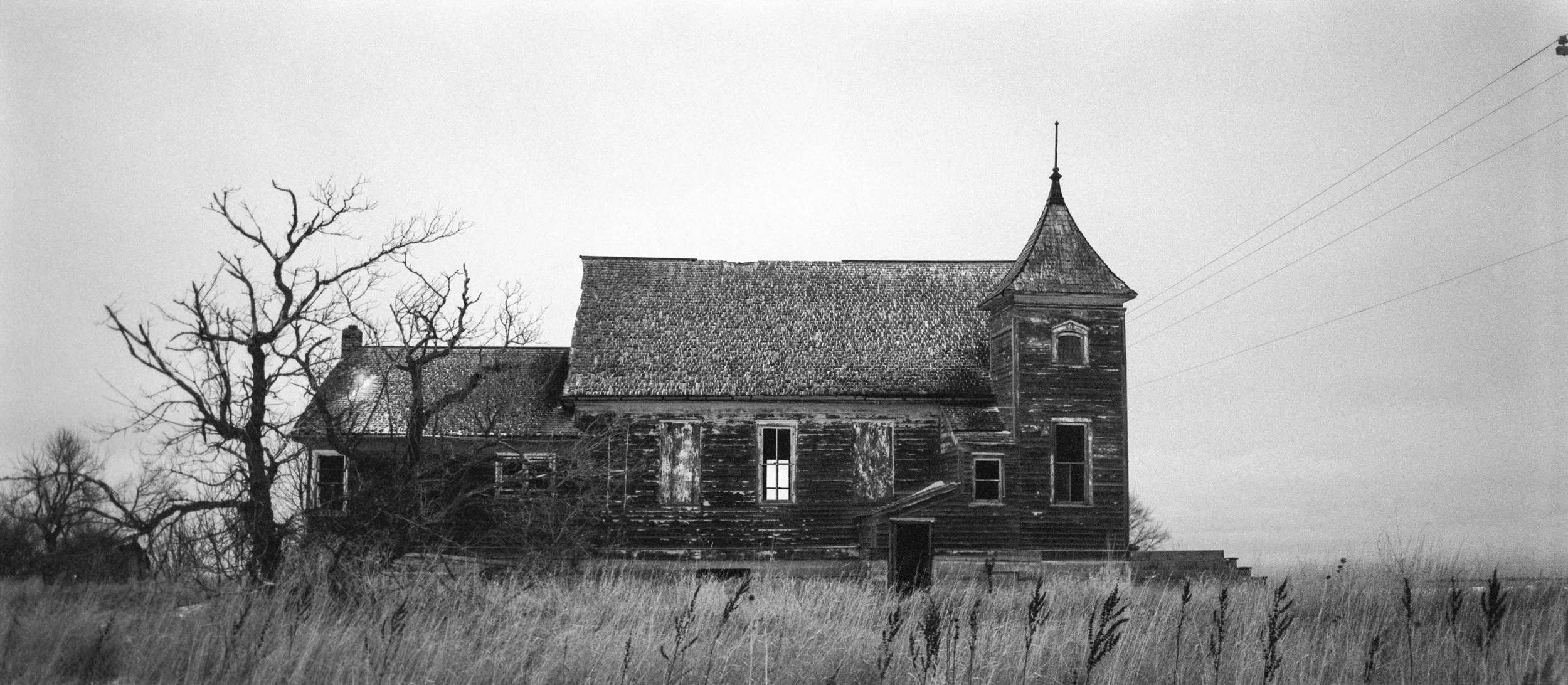
When Joseph moved to North Dakota ten years ago, he was immediately drawn to the abandoned farmsteads, houses, and barns that he encountered when driving even a short distance out of Minot on gravel roads. These places had similar unknown, unknowable stories, and he began to shoot them. In his mind, he could ‘see’ the movements, the labors, the day-to-day drudge of the people that once inhabited these places. His portraits of these places have the same kind of energy as an Alexey Titarenko photograph. Unseen toiling by long-dead husbands, sons, daughters, and wives; unnamed farmhands, whose collective efforts altered these landscapes and left behind husks that bear witness to their labor.
“My body of work explores themes primarily related to the loss of usefulness of man-made objects and how these objects can prompt a palpable empathetic response in the viewer. I present these objects as portraits. I don’t take photographs that are pretty, or that flatter. I take photographs that, I hope, make the viewer uncomfortable, reminiscent, or disquieted.
North Dakota is rich with objects left behind from stories that ended long ago. I connect, very deeply, with the people on the other side of time at each of these locations. In nearly all cases with the imagery presented in this body of work, those people are dead. This is part of my need to document these locations - when these places, and the things used by those people, no longer remain, who will remember they were ever here? The stories - why they were here, what they did, and why they left - will all be unknowable.”
Please join us at the James on Sunday, November 8, at 2 PM for the artist reception.
